„Methane Monitoring of abandoned coal mines ” (MEMO)
Source of funding: The European Union’s Research Fund for Coal and Steel (RFCS) , grant 101216769
Task Title: „Methane Monitoring of abandoned coal mines ”
The value of the funding is 1 967 484,62 EUR, with the total value of the project amounting to 3 279 142,90 EUR
Task description: The MEMO project addresses key challenges related to the quantification and management of methane emissions from abandoned coal mines in the EU. The methodology for inventorying these emissions has not yet been fully established. A critical issue is compliance with EU emission thresholds, which requires continuous data collection. This remains challenging for existing methane and flow sensors, particularly airborne technologies.
MEMO aims to develop robust, EU-wide methodologies for the accurate inventory of methane emissions. This includes classifying abandoned mines according to their susceptibility to methane emissions, defining methods based on emission factor estimates tailored to EU needs, and assessing the feasibility of accurately measuring methane fluxes down to 0.5 t/year.
The project objectives include establishing a methodology for methane emission inventorying, categorizing abandoned mines based on their emission potential, developing an approach for quantification using methane emission factors, and evaluating methane measurement techniques.
By integrating experimental, numerical, and field research, MEMO aims to develop and validate a comprehensive methane monitoring system that improves measurement accuracy and supports compliance with EU regulations.
Website of the project: www.memo.gig.eu
Contact person: Ph.D. Eng. Paweł Jamróz
„Fire Risk Assessment and Management of European Coal Heaps” (FRAM)
Source of funding: The European Union’s Research Fund for Coal and Steel (RFCS) , grant 101216667
Task Title: „Fire Risk Assessment and Management of European Coal Heaps”
The value of the funding is 1 452 209,49 EUR, with the total value of the project amounting to 2 420 349,15 EUR.
Task description: The FRAM project focuses on the assessment and management of fire risk in coal waste heaps across Europe, which pose a significant environmental and social threat. The aim of the project is to develop modern methods for the early detection and prevention of self-heating and spontaneous combustion in spoil heaps using drone-based thermal imaging, real-time gas sensors, and predictive models based on artificial intelligence. An important part of the project will also be the inventory and classification of spoil heaps in terms of fire risk and environmental impact, which will support reclamation activities and the development of environmental policies within the EU.
Website of the project: www.project-fram.com
Contact person: D. Sc. Eng. Przemysław Skotniczny, Associate Professor

Project title: Investigation of CO2-Enhanced Shale Gas Recovery (CO2-ESGR) processes through CO2/CH4 exchange studies in shales under laboratory-simulated in situ stress-pressure-temperature conditions
Source of funding: National Science Centre
Call: OPUS 29
Project number: 2025/57/B/ST10/02593
Implementation period: February 13, 2026 – February 12, 2030
Project budget: PLN 1 810 060
Project manager: D. Sc. Eng. Mateusz Kudasik, Associate Professor
Abstract
The growing demand for energy, as well as the advancing climate issues resulting from greenhouse gas (GHG) emissions, contribute to the search for new sources of natural gas reserves, while reducing emissions and utilizing industrially captured CO2. One potential method for CO2 storage is geological sequestration in shale formations, where large deposits of methane (CH4) occur. The process of high-pressure CO2 injection into deep (even up to 4,000 m) shale formations is intended to stimulate the processes of CO2/CH4 exchange, as a result of which CO2 is trapped in the pore space of the shales, and shale gas (consisting mainly of CH4) is displaced and captured (CO2-ESGR technology). The unsuccessful attempts to extract shale gas in Poland, carried out between 2013 and 2017, led to the abandonment of further attempts to exploit this energy source. However, in light of the global energy crisis and the technological advancements that have occurred over the past decade, the topic of shale gas exploitation in Poland is being revived. Therefore, it is crucial that the exploitation of poorly explored shale gas deposits in Poland, as well as the application of new technological solutions such as CO2-ESGR, must be preceded by detailed laboratory tests, in conditions corresponding to in situ, as well as a series of numerical simulations. The aim of the project is to conduct laboratory studies of the CO2-ESGR technology under stress-pressure-temperature conditions corresponding to in situ, at depths of up to 4000 meters. In such conditions, the stress exerted on the rocks is about 100 MPa, the shale gas pressure is about 10-50 MPa, and the temperature is up to 130oC. As part of the project, two unique research setups (IMG-SSR and IMG-GEX) will be built, which will enable simulating in situ conditions and conducting studies on the structural and sorption properties of shale on one of these stand, as well as performing seepage and CO2/CH4 exchange experiments on the second station. The studies will be conducted on 6 samples of core fragments of shales from Poland, mainly from the Baltic-Podlasie-Lublin basin region. The results of the structural and sorption studies obtained on the IMG-SSR analyzer on samples under stress-pressure-temperature conditions corresponding to in situ, compared with the results of studies of samples under stress-free conditions, will enable the determination of the impact of stress on the volume change, porosity, and pore volume in the rock. Moreover, it will be possible to determine the extent to which laboratory-measured parameters differ from those of the rock under in situ conditions deep underground. Permeability tests will be conducted on the IMG-GEX apparatus using the steady-state flow method, with permeability coefficients determined using Darcy’s law, as well as the absolute permeability of Klinkenberg. By comparing the permeability of cores perpendicular and parallel to the bedding, as well as the fracture permeability of these cores, the impact of the fracturing process on the stimulation of gas flow in various directions within the shale formation will be determined. The most important experiments of the project, CO2/CH4 exchange, will be carried out on the IMG-GEX apparatus and will consist of injecting CO2 into a shale sample, which will be initially saturated with CH4. This process is intended to induce gas mixture (CO2/CH4) exchange in the pore space and CO2/CH4 exchange sorption on the surface of the shale pores. These experiments will be conducted under laboratory-simulated in situ stress-pressure-temperature conditions, making them pioneering laboratory experiments. Based on these experiments, the efficiency of the CO2-ESGR process will be evaluated, as well as the exchange selectivity and the rate and spatial range of the exchange zone. The results of the CO2/CH4 exchange experiments will serve as the basis for the construction of a numerical model. The final stage of the project will involve the development of a numerical model based on the results of the conducted analyses. Numerical simulations will allow for the reconstruction of CO2-ESGR processes under in situ conditions on a macro scale. The outcome of the project will be the results of these simulations, which will make it possible to determine the temporal and spatial rate of the CO2-ESGR process under field conditions. This, in turn, will enable an assessment of the feasibility and applicability of this technology in Poland.
Contact person: D. Sc. Eng. Mateusz Kudasik, Associate Professor
„Sinkhole hazard and risk management in post-mining areas” (SIRIMA)
Source of funding: The European Union’s Research Fund for Coal and Steel (RFCS) and the Ministry of Science and Higher Education (grant 5997/FBWiS/2024/2).
The task was funded from the state budget under the program called „Projekty Międzynarodowe Współfinansowane”
The value of the funding is 476 898 PLN, with the total value of the project amounting to 1 324 719 PLN.
In the SIRIMA project we will use new methodologies to study the conditions under which the sinkhole occurrences in post mining areas, where the natural groundwater level is restored. The main goal of the project is to reduce the risk of uncontrolled and unexpected discontinuous movements of the Earth’s surface, mainly sinkholes, in the areas of closuring mines and during the flooding process in European countries. This will be achieved through creation a new methodology to determine the hazard of discontinuous deformations in post-mining areas. Current computational and technological capabilities enable a new approach to the problem and will allow for the determination of regions at hazard of sinkholes. The research conducted as part of the project will answer the question of how the process of decommissioning a mining plant takes place, the accompanying changes in measurable physical and spatial parameters of the geological centre will have an impact on the hazard of formation of discontinuous deformation in the form of sinkholes.
Website of the project: www.sirima.gig.eu
Contact person: Prof. D.Sc. Eng. Krzysztof Tajduś
“Reduction of Ventilation Air Methane Emissions in the Coal Mining Transformation Process” (ProVAM)
Source of funding: The European Union’s Research Fund for Coal and Steel (RFCS) and the Ministry of Science and Higher Education (grant 5734/FBWiS/2024/2).
The task was funded from the state budget under the program called „Projekty Międzynarodowe Współfinansowane”
Task Title: “Reduction of Ventilation Air Methane Emissions in the Coal Mining Transformation Process”
The value of the funding is 528 678 PLN, with the total value of the project amounting to 1 468 551 PLN.
Task Description: The aim of the project is to achieve progress in the implementation of methane utilization technology emitted by coal mine ventilation shafts through in-situ research, laboratory studies, and modeling conducted by an international consortium of research institutions, industrial partners, and universities.
Contact person: D. Sc. Eng. Jerzy Krawczyk, Associate Professor
Projects funded from the state budget under the “Premia na Horyzoncie 2” initiative
PICTO
Task title: “Reducing environmental risk during longwall coal mining in bituminous and lignite coal mines acronym PICTO”
Funding value and total task value: 514,950 PLN
Task description: The funding covers salary supplements for individuals participating in the project titled “Reducing environmental risk during longwall coal mining in bituminous and lignite coal mines acronym PICTO” carried out under the Research Fund for Coal and Steel (RFCS), based on agreement No. 800711/2018; and the International Co-Financed Projects program, based on agreement 531739/PnH2/2021.
i2MON
Task title: “Integrated monitoring of the impact of mining activities on the environment acronym I2MON”
Funding value and total task value: 196,582 PLN
Task description: The funding covers salary supplements for individuals participating in the project titled “Integrated monitoring of the impact of mining activities on the environment acronym I2MON” carried out under the Research Fund for Coal and Steel (RFCS), based on agreement No. 800689; and the International Co-Financed Projects program, based on agreement 540032/PnH 2/2022.
MERIDA
Task title: “Environmental risk management during and after mine closure acronym MERIDA”
Funding value and total task value: 271,992 PLN
Task description: The funding covers salary supplements for individuals participating in the project titled “Environmental risk management during and after mine closure acronym MERIDA” carried out under the Research Fund for Coal and Steel (RFCS-2020), based on agreement No. MERIDA RFCR-CT-2015-00004; and the International Co-Financed Projects program, based on agreement 531739/PnH2/2022.

“Production Face Environmental Risk Minimisation in Coal and Lignite Mines” (PICTO)
Contract No. 800711
Period of implementation: September 1, 2018 – August 31, 2021.
Source of funding: The European Union’s Research Fund for Coal and Steel (RFCS) and the Ministry of Science and Higher Education (grant W93/FBWiS/2018).
Project participants:
- Strata Mechanics Research Institute of the Polish Academy of Sciences — project coordinator:
- Division of Flow Metrology,
- Division of Micromeritics
- Division of Mine Ventilation.
- Główny Instytut Górnictwa (Poland),
- Imperial College London (Great Britain),
- Eickhoff Bergbautechnik GmbH (Germany),
- Premogovnik Velenje (Słovenia),
- Polska Grupa Górnicza S.A. (Poland).
The aim of the project is to develop a prototype control system for the operation of a mining machine in the mining face in order to eliminate or minimize undesired and unplanned production downtime due to exceeding permissible values of gas emissions in mining areas of underground coal and lignite mines through monitoring of the production process and environment and appropriate adjustment of equipment operation to these conditions.
Project reports:
Contact person: D. Sc. Eng. Jerzy Krawczyk, Associate Professor
“Management of Environmental RIsks During and After mine closure” (MERIDA)
Number: RFCR-CT-2015-00004
Period of implementation: December 15, 2015 — December 15, 2019.
Source of funding: The European Union’s Research Fund for Coal and Steel (RFCS) and the Ministry of Science and Higher Education (grant 3582/FBWiS/2016/2).
Environmental Risk Management During and After Mine Closure acronym MERIDA
The task was funded from the state budget as part of the “Horizon 2 Premium” initiative.
Task Title: “Environmental Risk Management During and After Mine Closure, acronym MERIDA” Funding amount and total task value: 271,992 PLN
Task Description: The funding covers supplements to salaries for individuals participating in the project titled “Environmental Risk Management During and After Mine Closure, acronym MERIDA”, carried out under the Research Fund for Coal and Steel (RFCS-2020), based on agreement no. MERIDA RFCR-CT-2015-00004; and the International Co-Funded Projects program, based on agreement 531739/PnH2/2022.
Project participants:
- Główny Instytut Górnictwa – project coordinator,
- Strata Mechanics Research Institute of the Polish Academy of Sciences:
- Division of Rock Mechanics,
- Division of Mine Ventilation.
- DMT GmbH & Co. KG (Germany),
- Imperial College London (Great Britain),
- University of Exeter (Great Britain),
- University of Oviedo (Spain),
- Technical University of Ostrava (Czech Republic),
- HUNOSA (Spain),
- French National Institute for Industrial Environment and Risks (France),
- Kompania Węglowa S.A. (since 2016 — Polska Grupa Górnicza S.A.).
The aim of the project is to develop a methodology for managing the environmental risks associated with the closure of coal mines, both during and after closure, and to develop an integrated approach that will allow the industry to implement the methodology anywhere. MERIDA will produce a best practices manual to be used by the industry and decision-makers for the systematic assessment of the main environmental threats of closure, both qualitatively and quantitatively. Strata Mechanics Research Institute was responsible for tasks related to subsidence and uplift hazards as well as gas emissions.
Contact person: D. Sc. Eng. Jerzy Krawczyk, Associate Professor

“Integrated Mining Impact Monitoring (i2MON)”
Period of implementation: July 1, 2018 — August 30, 2022.
Source of funding: The European Union’s Research Fund for Coal and Steel (RFCS).
Project participants:
- Strata Mechanics Research Institute of the Polish Academy of Sciences — project coordinator:
- Division of Flow Metrology,
- Division of Rock Mechanics,
- Division of Mine Ventilation.
- DMT GmbH & Co. KG (Germany),
- EFTAS Fernerkundung Technologietransfer GmbH (Germany),
- Technische Universiteit Delft (Holand),
- Hochschule Mainz — University of Applied Sciences (Germany),
- Technische Universität Bergakademie Freiberg (Germany),
- Laserdata GmbH (Austria),
- Lausitz energy Bergbau AG (Germany),
- Airbus Defence & Space GmbH (Germany),
- Polska Grupa Górnicza S.A. (Poland).
Project website: http://i2monproject.eu/
Contact person: Prof. D.Sc. Eng Krzysztof Tajduś
CO2/CH4 exchange sorption on carbonaceous matter under circular loading condition
NCN, OPUS 12, 2016/23/B/ST8/00744
Implementing Entity:Strata Mechanics Research Institute, Polish Academy of Sciences
Project Manager : D.Sc. Eng. Norbert Skoczylas
Amount awarded: 611,500 PLN, Commencement: 2017-10-18, Completion: 2021-10-17
1. Purpose of conducted research / research hypothesis
The purpose of the ongoing work will be to study the course and mechanism of CO2/CH4 exchange sorption in carbon material under circular loading conditions. The planned research will include a number of scientific problems to be solved. Among other things, they will make it possible to thoroughly analyze changes in sorption capacities and volumes (sorption swelling/shrinkage) of a coal sample at different circular pressures for different sorption equilibrium points, as well as to analyze qualitative and quantitative changes in the mechanism of exchange sorption at different circular loads and different pressure gradients. In addition, the effect of the CO2/CH4 exchange sorption process on the coal material under circular loading condition on its structural properties will be determined.
2. Research method / methodology used
The research plan includes main sorption studies, i.e.: analysis of the course of CO2/CH4 exchange sorption processes on a carbon sample, exchange efficiency of sorbed gases, kinetics of exchange zone displacement in the sample under circular loading conditions, sorption swelling, and additional studies of changes formed in the porous structure of the sample. The main sorption studies will be realized using the isobaric-isothermal volumetric method and the flow method while maintaining a constant gas pressure gradient. For these studies, a unique proprietary apparatus will be constructed, which, realizing the individual research objectives, will enable a comprehensive evaluation of the effect of circular loading on the parameters of the carbon-gas system under isothermal and isobaric conditions.
Before and after the main sorption tests, selected carbon samples will be subjected to technical and structural analyses. For additional structural studies, scanning electron microscopy will be used to observe changes in the surface topography of the samples and determine their phase composition. Mercury porosimetry, low-pressure gas adsorption and helium pycnometry will be used to characterize changes in the porous structure of the samples. These methods will allow determination of changes in porosity, pore size and distribution in the samples after exchange sorption tests under load.
3. Impact of expected results on the development of science, civilization, society
The mechanism of sorption processes in coal has been the subject of scientific research for many years. The sorption processes of single gases and their mixtures on coal material are well recognized. Studies of gas sorption on coal material under load have been conducted. An in-depth review of the literature has shown that a topic as yet unrecognized is the issue of CO2/CH4 exchange sorption on coal material under circular loading.
The multitude of dependencies that can be both experimentally observed and quantitatively estimated during sorption processes in the circular loading state of a coal sorbent is a missing link in the broad research of the coal-gas system. Certainly, the proposal to study the exchange sorption of CO2/CH4 under coal circular loading conditions taking into account the factor of time and space is unique. Such research is envisaged in the implementation of the present project. The result of the project will be a detailed description of the relationship: exchange sorption – sorbent circular loading – sorbent swelling.
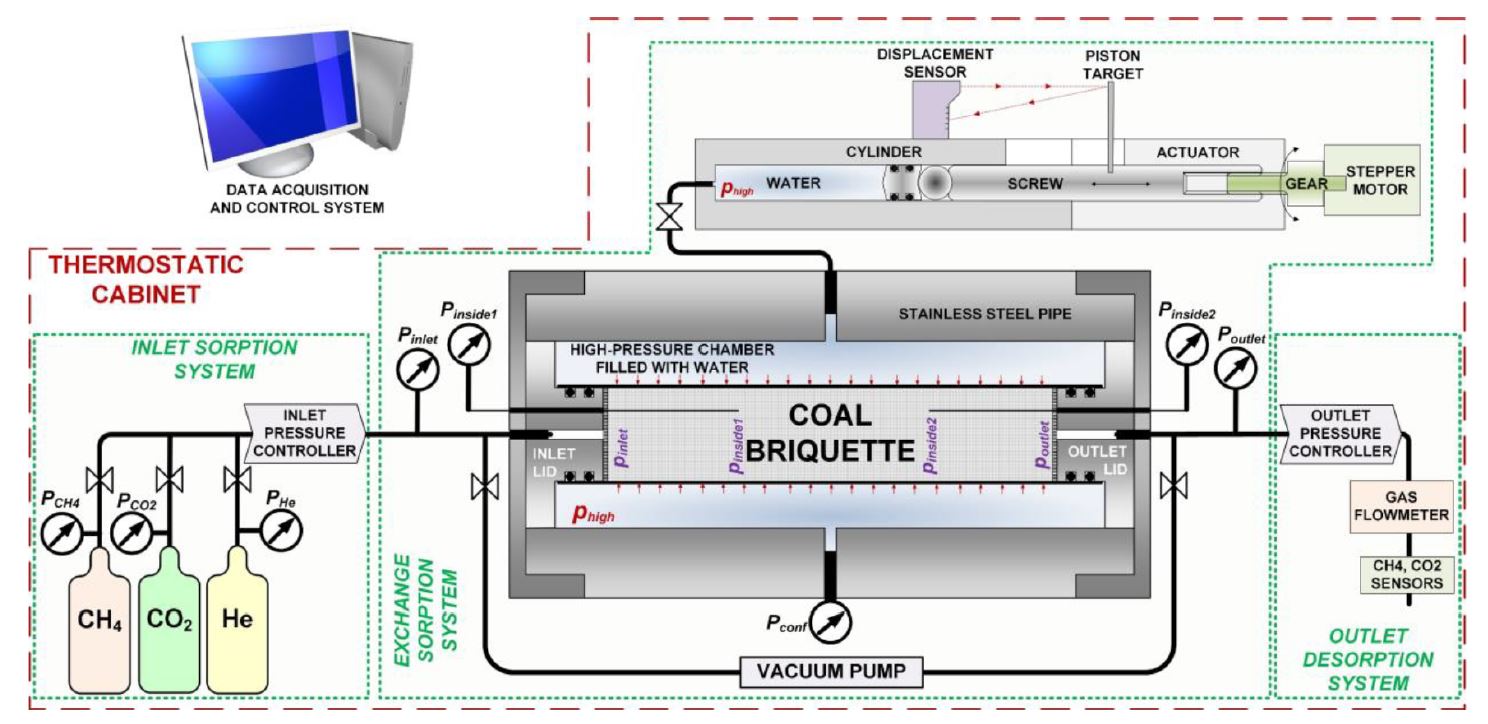
Research apparatus built as part of the project implementation.
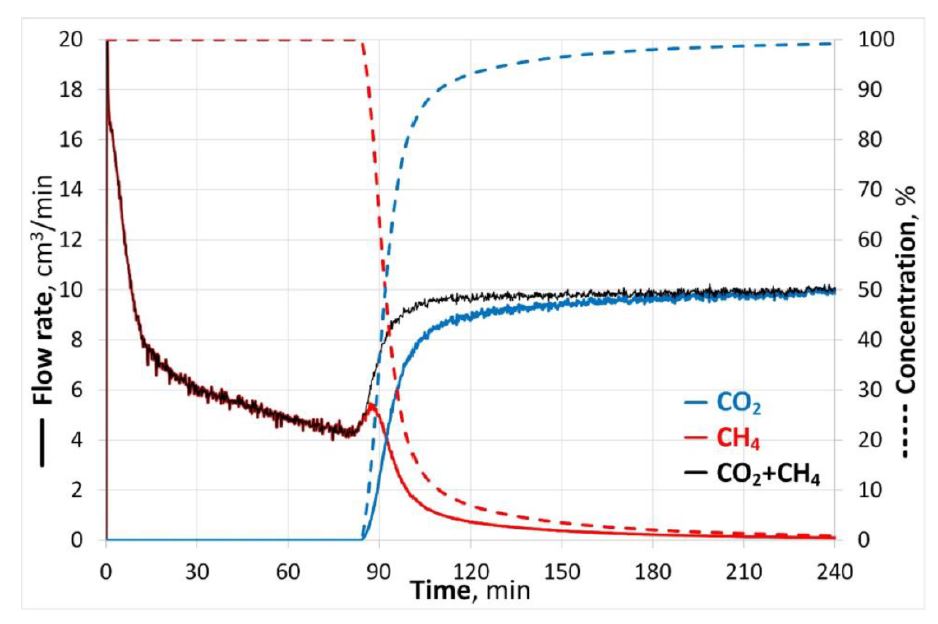
Examples of results recorded during sorption exchange experiments.